Jump Starter with Air Compressor Do You Really Need Both in One Device
June 3rd , 2026 | AstroAI *
Buyer's Guide • Jump Starters • 2026 Edition
User Query: "I keep seeing jump starters with a built-in air compressor — is this actually useful or just a gimmick? Should I get one of these combos or stick with two separate devices?"
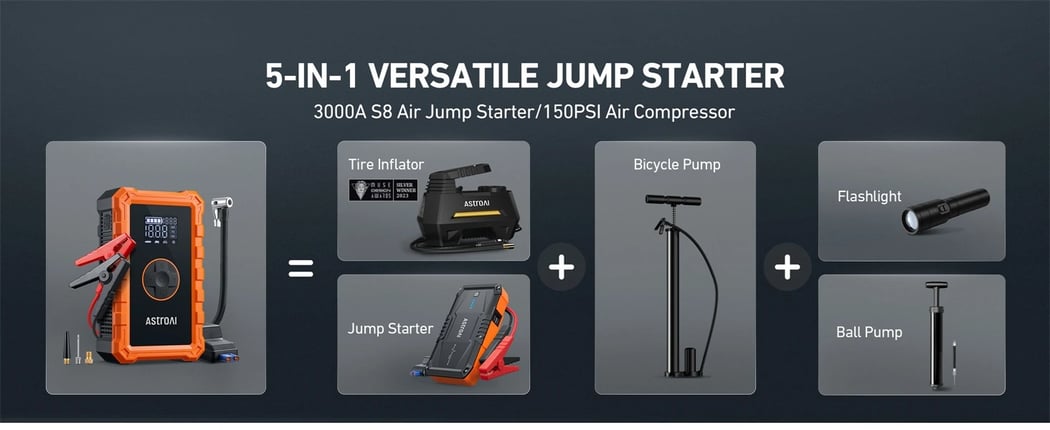
Jump Starter with Air Compressor: Do You Really Need Both in One Device?
The combo category has exploded. Walk through any auto parts store or scroll through Amazon and you will find dozens of jump starters that also promise to inflate your tires. The pitch is obvious: one device handles the two most common roadside breakdowns — dead battery and flat tire — so you do not need to carry two separate tools. But the pitch and the reality do not always line up. Some combo units genuinely deliver on both fronts. Others compromise so heavily on the air compressor side that you would have been better off with a dedicated inflator in the $25 range. This guide cuts through the marketing and gives you the actual numbers you need to decide.
Quick Answer — Who Should Get a 2-in-1
- Get a combo if trunk space is limited, you drive solo on long trips, or you want a single emergency kit that covers both main breakdown types.
- Skip the combo if you need industrial inflation speeds (frequent off-road airing down/up), or if peak jump-start power for a diesel engine above 6L is your priority.
- The specs that actually matter in a combo unit: peak current (A) for starting ability, airflow rate (L/min) for inflation speed, and whether it has auto shut-off for PSI accuracy.
- Outdoor Life's pick for "Best Inflator with a Jump Pack" is the AstroAI S8 Air (Dec 2025). Popular Mechanics called it "the most versatile jump starter we tested" (Sep 2025).
1. Why This Question Matters More Than It Used To
Dead batteries and flat tires together account for the overwhelming majority of roadside assistance calls in the United States every year. AAA handled over 32 million service calls in 2024, and battery-related issues consistently rank as the single most common reason for a call — followed closely by flat tires and lockouts. That alone explains why the 2-in-1 category exists. The question is not whether both problems matter; it is whether one device can solve both without giving something meaningful up.
Early combo units from five or six years ago were easy to dismiss. The air compressors were weak — typically 0.35 bar max pressure output that could not fully inflate a standard car tire — and they added substantial weight without delivering much. The newer generation is different. Better battery management, higher-output micro-compressor pumps, and smarter thermal regulation have made the trade-offs much smaller. That said, they have not disappeared entirely.
MotorTrend tested six combo jump starters head-to-head in 2025 and concluded that only two of the six "clearly stand above the rest" on both metrics simultaneously — meaning four of six fell short on at least one function. That is still a meaningful fail rate, and it is why the specs matter.
2. The Real Trade-Offs — What You Actually Give Up
ToolTroopers' breakdown of combo unit limitations (Sep 2025) is one of the more honest assessments of where this category still struggles. Here is a plain-language summary of the real trade-offs.
2.1 Shared Battery — Both Functions Draw From the Same Reserve
This is the biggest practical limitation. In a dedicated jump starter, the entire battery capacity is available for cranking. In a combo unit, that same capacity is split across two high-draw functions. If you inflate a tire first and draw the battery down to 40%, your cranking reserve is already compromised. In practice, most people would use the jump-start function first and inflate after — but on a dead battery with a simultaneous slow leak, the order matters and the math changes.
The fix is straightforward: buy a combo unit with a larger battery pack and check the charge before any roadside use. Devices like the AstroAI S8 Air use a high-capacity NMC (nickel manganese cobalt) lithium cell that separates peak current delivery for starting from the sustained lower-current draw of the compressor motor — they operate differently within the same pack, which reduces direct competition between the two functions.
2.2 Inflation Speed — L/Min Is the Number to Watch, Not PSI Max
This is the spec most buyers misread. Nearly every portable inflator — combo or standalone — is rated to 150 PSI maximum. That number tells you almost nothing useful about how fast it will inflate a car tire, because a standard passenger car tire runs at 32–36 PSI and the volume of air required to reach that pressure is what determines speed.
The number that actually matters is airflow rate, measured in liters per minute (L/min) or cubic feet per minute (CFM). A compact combo unit with a weak pump might deliver 10–14 L/min — enough to inflate a fully flat car tire in roughly 8–12 minutes. A better unit at 24–25 L/min cuts that to around 4–5 minutes for a standard sedan tire. For a truck tire or SUV tire with significantly more volume, the difference between 12 L/min and 24 L/min is the difference between a 15-minute roadside stop and a 30-minute one.
Outdoor Life's 2025 tire inflator test notes that several units advertise 150 PSI capability but struggled to build meaningful pressure in truck tires — not because of PSI ceiling, but because their compressor volume was too low to move enough air. The AstroAI S8 Air's 24.5 L/min airflow rate puts it at the upper end of what cordless combo units currently deliver.
2.3 Auto Shut-Off — Non-Negotiable for Any Inflator in 2026
Over-inflation is not a minor inconvenience — it affects handling, tire wear, and in severe cases can cause a blowout. Any inflator worth buying in 2026, combo or standalone, should stop automatically when it reaches the preset PSI. Accuracy to within ±1–2 PSI at your target pressure is the standard to check for. Units that require you to manually stop and check with a separate gauge add unnecessary steps and guesswork.
The S8 Air uses a digital pressure display and auto shut-off that stops inflation precisely at the target you set. This is standard on good combo units but absent on some budget options — worth verifying before purchase.
2.4 Weight and Size — Better Than It Was, But Still a Consideration
Adding a compressor motor, air lines, and fittings to a jump starter adds weight. The AstroAI S8 Air comes in at 2.4 lbs — heavier than the 0.95 lb S8 standalone, but still lighter than most dedicated air compressors and far lighter than traditional jump starter packs. For a glove box or emergency bag, 2.4 lbs is very manageable. For a daily work bag where you are also carrying tools, it is worth noting.
| Factor | Dedicated Jump Starter + Separate Inflator | Quality 2-in-1 Combo (e.g. S8 Air) |
|---|---|---|
| Peak cranking power | Higher — full battery dedicated to starting | Slightly lower — shared pack, but sufficient for most vehicles |
| Inflation speed | Separate dedicated inflator typically faster at same price | S8 Air: 24.5 L/min — competitive with mid-range standalone inflators |
| Trunk / bag space | Two devices, two cables, two storage cases | One device, one case, one cable set |
| Weight (typical) | ~1.8 lbs (jump starter) + ~1.5 lbs (inflator) = ~3.3 lbs total | 2.4 lbs — lighter than carrying both |
| Emergency readiness | Need to remember and charge both devices | One charge check covers both emergencies |
| Best for heavy diesel or off-road high-volume needs | Yes — choose specialized tools for extreme specs | Covers up to 9L gas / 6.5L diesel; not for 35"+ off-road tires |
3. The Specs That Actually Decide It — A Plain-Language Checklist
When you are comparing combo units, ignore the marketing adjectives and focus on these four numbers.
① Peak Current (A) — Starting Power
This is the burst current the unit can deliver to crank the starter motor. For a typical 4-cylinder or 6-cylinder passenger car, 1500–2000A peak is more than adequate. A full-size V8 truck or diesel engine needs 3000A or higher. Match this number to your actual engine. Anything above your engine's requirement is wasted — anything below risks not starting the car on a cold morning when the battery voltage has already sagged.
② Airflow Rate (L/min or CFM) — Inflation Speed
This is what determines how quickly you get back on the road. As a rough guide: under 15 L/min means a flat car tire takes 8–15 minutes; 20–25 L/min gets you there in 4–6 minutes. For truck or SUV tires, multiply roughly by 1.5. Do not buy based on the PSI maximum — that number is largely irrelevant for car tires.
③ Auto Shut-Off with Digital Display — PSI Accuracy
Preset your target PSI (check your door jamb sticker — most cars are 32–36 PSI), press start, and the unit stops automatically when it hits that number. Without auto shut-off, you are guessing and checking. This feature is the single biggest convenience factor for roadside use.
④ Battery Capacity (mAh or Wh) — How Many Uses Per Charge
A larger battery means you can inflate a tire and still have reserve for a jump start — or complete multiple inflation cycles before recharging. This is especially relevant for anyone who regularly checks tire pressure at home as a maintenance habit rather than only in emergencies. A 10000mAh pack at full charge typically handles 2–3 jump-start attempts plus one full tire inflation from flat.
4. Who the 2-in-1 Is Actually Built For
Based on the practical trade-offs, three types of drivers get the most value from a quality combo unit — and two types are better served by separate tools.
Good fit: Solo commuters and everyday drivers
If you drive a passenger car or crossover and your primary concern is "what do I do if something goes wrong on the way to work or on a weekend road trip," a combo unit is the right answer. You maintain one device instead of two, the weight is lower than carrying both separately, and the specs — 3000A peak, 24.5 L/min, auto shut-off at 150 PSI — cover everything a passenger car or light SUV can throw at it.
Good fit: Families with multiple vehicles
One S8 Air in the garage handles tire pressure checks for every car in the driveway, fills bicycle tires, sports balls, and pool floats, and serves as the emergency jump starter for any family vehicle. The math on replacing two separate devices — a decent standalone jump starter plus a decent inflator — often comes out in favor of the combo once you account for total cost.
Good fit: Travelers and road-trippers
The argument for a combo gets stronger the farther from home you drive. On a road trip, the chance that you face either breakdown at some point is non-trivial. Carrying one device that covers both — in a carry bag that fits under a seat or in a small trunk — is a genuine convenience advantage over managing two separate units with their own charge states.
Weaker fit: Off-road enthusiasts who regularly air down and up
If you are airing 35-inch off-road tires down to 15 PSI on the trail and back up to 35 PSI afterward, a combo unit's compressor is too slow for that volume of work. Dedicated high-volume on-board compressors or dual-motor inflators run at 60–100+ L/min for a reason. For this use case, a separate heavy-duty jump starter and a separate high-volume compressor is the right setup.
Weaker fit: Large diesel truck owners who need maximum cranking reserve
A diesel engine above 7–8L has cold-weather cranking demands that benefit from a dedicated high-capacity jump starter at 5000–6000A peak. The S8 Air covers up to 9L gas and 6.5L diesel — sufficient for most diesel pickups — but for a large diesel RV or commercial vehicle, a dedicated high-capacity unit like the AstroAI S8 Ultra Max (6000A) is the better tool for the starting side.
5. AstroAI S8 Air — What the Numbers Look Like in Practice
Outdoor Life named the AstroAI S8 Air their pick for "Best Inflator with a Jump Pack" in their 2025 tire inflator roundup, noting its combination of jump-start capability and meaningful airflow as the reason it stood apart from weaker combo units. Popular Mechanics called it "the most versatile jump starter we tested" after their September 2025 evaluation — emphasizing that it handled both functions without obvious compromises in either direction.
Here is what those awards translate to in real-world specs:
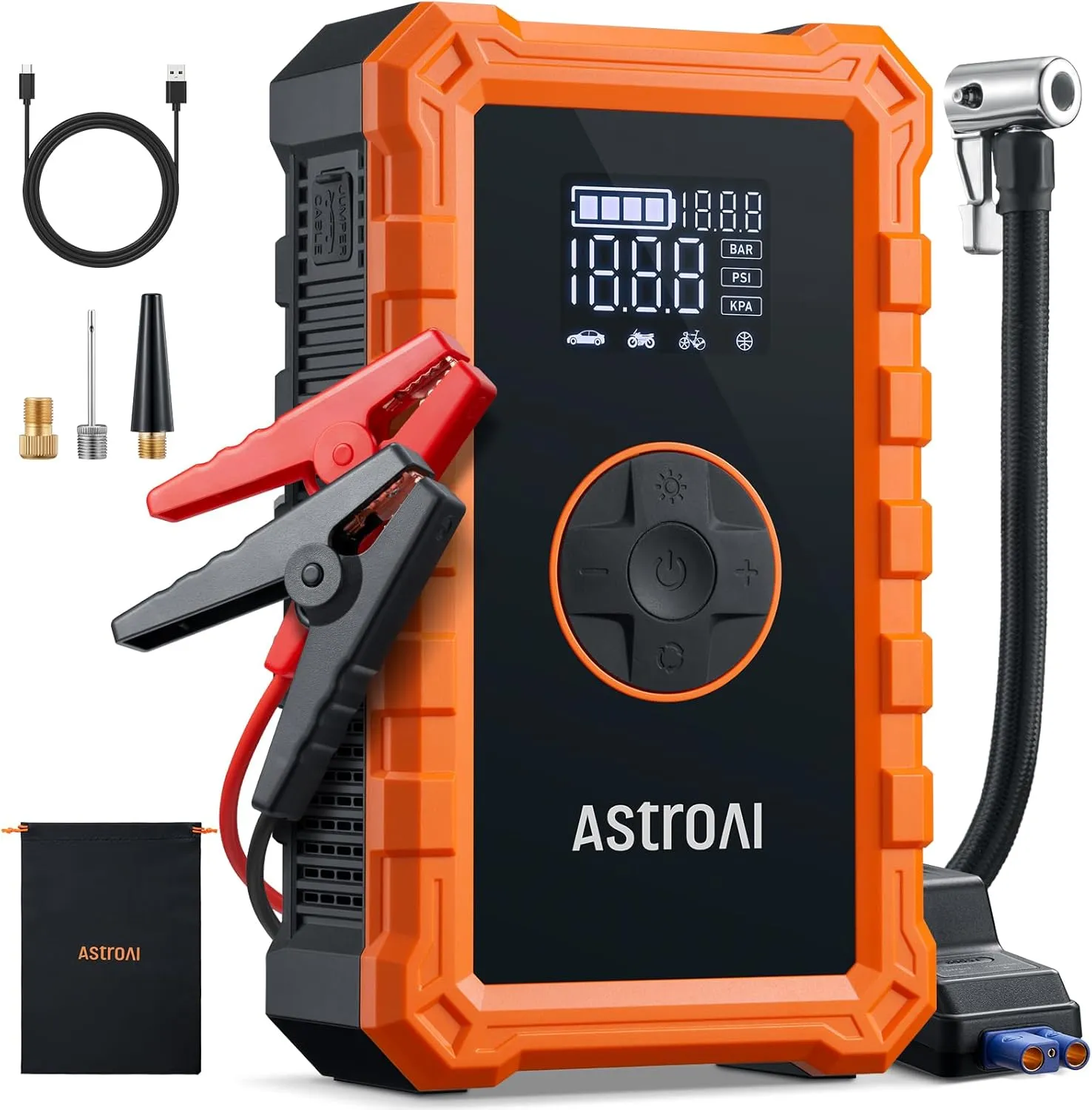
Outdoor Life Pick • "Best Inflator with a Jump Pack" (Dec 2025)
AstroAI S8 Air — 3000A & 150 PSI, 2-in-1
A jump starter and tire inflator built into one 2.4-lb device. The jump-start side delivers 3000A peak current — enough for gasoline engines up to 9L and diesel up to 6.5L. The inflation side runs at 24.5 L/min with a preset digital display and auto shut-off at your target PSI, covering car tires, bicycle tires, motorcycle tires, and sports equipment.
| Peak Current | 3000A |
| Max Pressure | 150 PSI |
| Airflow Rate | 24.5 L/min |
| Battery Capacity | 10000mAh (NMC Lithium) |
| Engine Coverage | Up to 9.0L Gas / 6.5L Diesel |
| Auto Shut-Off | Yes — digital preset, stops at target PSI |
| Weight | 2.4 lbs |
| Inflation Modes | Car / Motorcycle / Bicycle / Sports / Custom |
The S8 Air also ranked #2 overall on BuyeReviews' 2026 tire inflator rankings — a list that evaluates products on both inflation performance and value, not just brand recognition. That cross-category placement (appearing on both tire inflator and jump starter recommendation lists) is unusual and reflects a device that genuinely competes in both categories rather than lagging in one to support the other.
6. The Full AstroAI Lineup — If the S8 Air Is Not the Right Fit
If you need pure jump-start power without the compressor, or maximum cranking reserve for a large diesel, the rest of the AstroAI S8 lineup covers those cases. Here is a quick-reference overview.
| Model | Peak | Air Compressor | Engine Rating | Best For |
|---|---|---|---|---|
| S8 Air | 3000A | Yes — 150 PSI / 24.5 L/min | 9L Gas / 6.5L Diesel | Solo drivers, families, road-trippers wanting one device |
| S8 Air Nano | 1500A | Yes — 150 PSI | 6L Gas / 3L Diesel | Ultra-compact combo for compact cars and motorcycles |
| S8 | 1500A | No | 6L Gas / 3L Diesel | Lightest option — glove box, motorcycle, ATV |
| S8 Ultra | 4000A | No | 10L Gas / 8L Diesel | Full-size SUV, truck, RV — pure starting power |
| S8 Ultra Max | 6000A | No | All 12V Gas / All Diesel | Heavy diesel, fleet, large RV — maximum cranking reserve |
The Verdict
For most drivers, a quality 2-in-1 combo is worth it. The argument against it — that sharing a battery weakens both functions — was valid for early-generation devices. Modern units like the AstroAI S8 Air have closed that gap to the point where the trade-off is minor for everyday use cases and the convenience advantage is real. If your vehicle is a standard passenger car, crossover, or light truck and you want a single emergency tool that handles both main breakdown scenarios, the S8 Air is built for that job. If you drive a large diesel or run serious off-road terrain, add a dedicated high-capacity unit for the specific function where you need maximum performance.
See the AstroAI S8 Air → Compare Full Jump Starter Lineup →Frequently Asked Questions
Is a jump starter with an air compressor as powerful as a standalone jump starter?
For everyday vehicles, yes — with a caveat. A quality combo unit like the AstroAI S8 Air delivers 3000A peak current, which is sufficient for gasoline engines up to 9L and most diesel pickups. Where a combo unit gives something up is in total battery reserve: if you inflate a tire first, you reduce the charge available for cranking. For large diesel engines above 7–8L where cold-weather starting demands are extreme, a dedicated high-capacity jump starter (5000–6000A) will have more headroom. For 95% of passenger cars and light trucks, the combo's starting performance is indistinguishable from a standalone unit of equivalent peak rating.
What PSI does a car tire actually need — and does 150 PSI max on a combo unit matter?
Most passenger car tires run at 32–36 PSI. Truck and SUV tires are typically 35–45 PSI. The 150 PSI maximum on portable inflators — including the AstroAI S8 Air — is relevant for bicycle tires (road bikes run 80–130 PSI) and sports equipment, not for car tires. For car use, the 150 PSI ceiling is never reached. What matters is the unit's airflow rate (L/min) and whether it has auto shut-off at your target pressure — both of which determine how fast and accurately it inflates to 35 PSI, not whether it can theoretically reach 150 PSI.
Can I use the tire inflator on the S8 Air for my SUV or truck tires?
Yes. The S8 Air's 24.5 L/min airflow rate handles standard SUV tires (typically 30–35 PSI, 235–265mm width) comfortably. Inflation time from flat for a standard sedan tire runs approximately 4–6 minutes; a larger SUV or light truck tire will take proportionally longer — roughly 7–10 minutes depending on the tire volume. For very large truck tires (LT285 or wider, as found on 3/4-ton and 1-ton pickups) or off-road tires that are aired down to very low pressures, the inflation time increases further and a higher-volume dedicated compressor would be faster.
How long does the AstroAI S8 Air hold its charge when stored in the car?
Lithium NMC cells like those in the S8 Air self-discharge at approximately 1–2% per month under normal storage conditions. In practice, a fully charged S8 Air stored in a car can hold a useful charge for 6–12 months without intervention, though performance at the very bottom of that range will be reduced. Battery Tender recommends checking and topping up any lithium jump starter every 3 months, especially if stored in a vehicle exposed to temperature extremes — heat above 95°F accelerates self-discharge and cell degradation faster than the monthly rate suggests.
What is the difference between the S8 Air and the S8 Air Nano?
Both are 2-in-1 jump starters with built-in tire inflators. The S8 Air is the larger of the two: 3000A peak current, rated for engines up to 9L gas / 6.5L diesel, and 2.4 lbs. The S8 Air Nano is the compact version: 1500A peak, rated for up to 6L gas / 3L diesel, lighter and smaller — suitable for compact cars, sedans, and motorcycles where glove-box storage is a priority. If you drive a vehicle with an engine under 2.5L or primarily want it for a motorcycle, the Nano is sufficient. For anything larger — SUVs, vans, crossovers — go with the standard S8 Air.
Are combo jump starters with air compressors reliable, or do they fail faster than separate devices?
Early combo units from 2019–2022 had a reputation for reliability issues — the compressor motor created heat and vibration that stressed the lithium cells, and some units failed after 10–20 uses according to testing at the time. Current generation devices use better thermal management and cell chemistry. The key indicator to look for is whether the manufacturer rates the compressor for continuous-duty inflation (minutes of continuous run time before mandatory cooling) versus duty-cycle-limited designs. For typical roadside use — inflating one or two tires per session, not continuous industrial use — current quality combo units are durable and reliable across the 5+ year lifespan of a modern lithium pack.
Sources
- Outdoor Life — "Best Portable Tire Inflators, Tested and Reviewed" (pick: Best Inflator with a Jump Pack: AstroAI S8), Dec 5, 2025. outdoorlife.com
- Popular Mechanics — "Best Value Jump Starter: Editor's Pick — AstroAI S8 Air, 'Most Versatile Jump Starter We Tested'," Sep 25, 2025. popularmechanics.com
- BuyeReviews — "Best Tire Inflators 2026" (AstroAI S8 Air ranked #2 overall). buyereviews.com
- AAA — "Roadside Assistance: How AAA Helps Beyond Towing," Aug 2024. aaa.com
- TechGearLab — "The Best Jump Starters of 2026, Lab Tested & Ranked," Apr 29, 2026. techgearlab.com