ROADSIDE READINESS
Jump Starter with Air Compressor: One Kit or Separate Tools?
The car will not crank on Monday. Before Saturday’s drive, a tire needs air. Different problems—but the same question when you pack the trunk: should one device cover both, or should you carry separate tools?
Quick Answer
Choose a jump starter with an air compressor if you want occasional starting backup and tire top-ups in one kit. Choose separate tools if you inflate often, need a compressor for demanding tire jobs, already own a good inflator, or want independent equipment. Either way, match the starting function to your engine and the inflation function to the job—not just the biggest number on the box.
Two-in-One or Separate Tools? Choose by How You Will Use Them
If you are buying your first roadside kit for occasional use, a jump starter with an air compressor is a convenient starting point. If you already own one good tool, need frequent inflation, or want independent backup, separate tools are usually the more practical route.
Find the situation closest to yours below. The recommendation tells you which setup to consider—not which model fits your engine or tires.
|
Your situation
|
Recommended setup
|
Why it fits / what to check
|
|
You own neither tool and want backup for an occasional no-start or a slightly low tire.
|
Choose a two-in-one.
|
Keep both roadside functions in one kit. Check engine compatibility and the inflator’s operating limits before choosing a model.
|
|
You already have a reliable tire inflator.
|
Add a standalone jump starter.
|
Keep the inflator you like and buy only the missing function. The reverse also applies if you already own a suitable jump starter.
|
|
You regularly inflate tires or maintain several vehicles.
|
Choose separate tools.
|
Select the inflator for the workload and the jump starter for the engine. Check runtime and cooldown limits; a standalone inflator is not automatically continuous-duty.
|
|
You are taking a normal road trip and mainly expect occasional tire top-ups.
|
A two-in-one can be a practical choice.
|
You do not need separate tools simply because the drive is long. Choose separate equipment if independent backup matters more to you than keeping one kit.
|
|
You travel remotely and do not want one device problem to affect both jobs.
|
Choose independently powered tools.
|
If one device is depleted or unavailable, the other can still be usable. Keep both ready and plan how you will recharge or power them.
|
|
You need to inflate an air mattress at camp.
|
Bring a suitable mattress pump as well.
|
Use the roadside kit for the vehicle. Do not rely on its tire compressor for a mattress unless that low-pressure, high-volume use is explicitly supported.
|
|
You repeatedly refill off-road tires or work with large-volume tires.
|
Choose the compressor first; add a separate jump starter.
|
Match the compressor to tire size, airflow needs and duty cycle. A large peak-amp number or high maximum PSI does not establish suitability for that workload.
|
The simplest rule: combine for convenience; separate for a specific workload or independent backup. In either case, check starting compatibility and inflation capability separately.
What changes between the commute, the highway and the campsite?
The daily commute: keep the kit simple
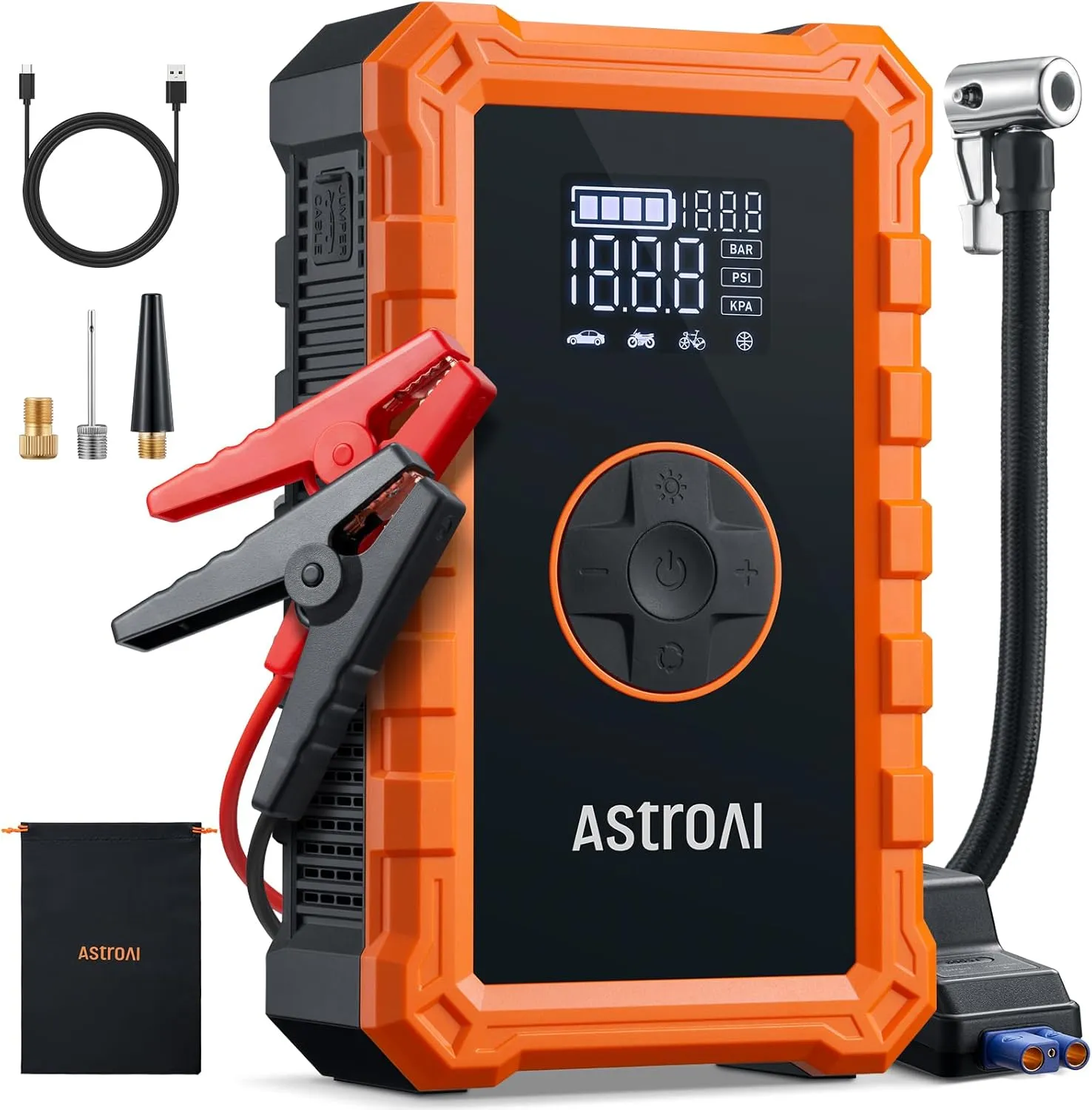
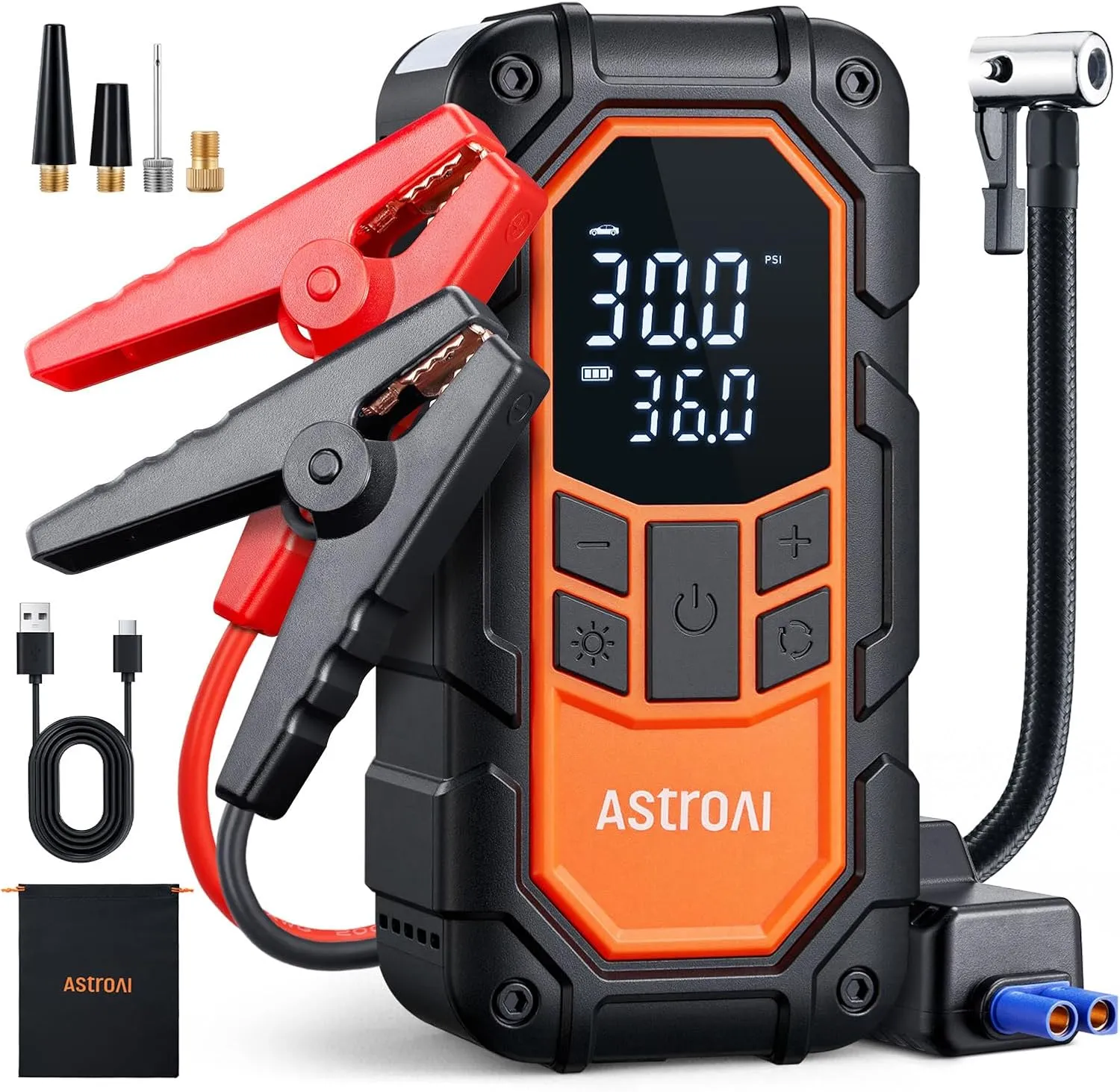
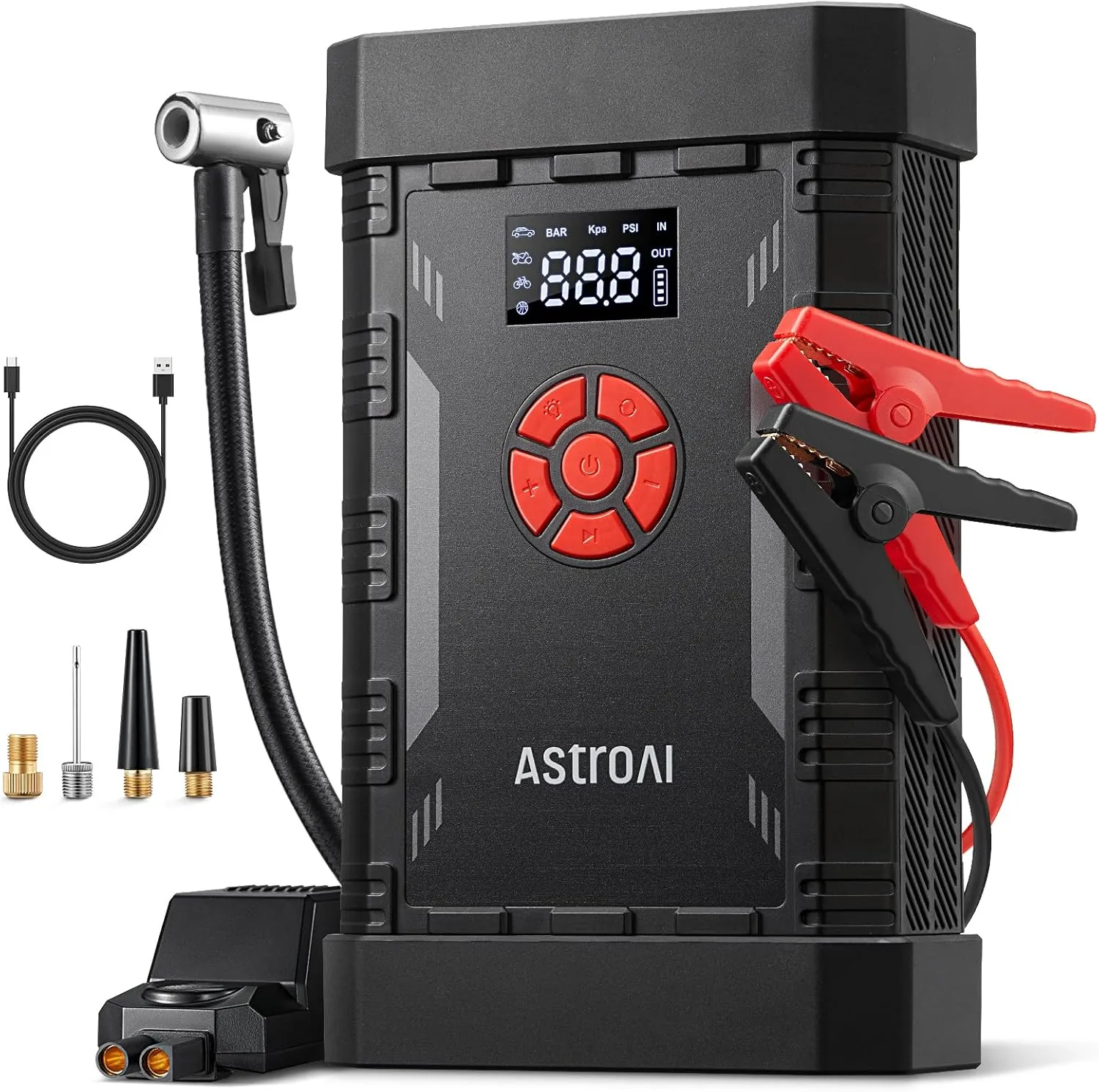
For a car that mostly travels between home, work and errands, the appeal is straightforward: fewer loose pieces to remember. A combination unit can make sense for occasional top-ups and an unexpected starting problem. S8 Air or S8 Air Nano is worth considering when the exact engine specification fits. MF139 offers another layout and a different published engine range.
But a car that repeatedly needs a jump or a tire that keeps losing pressure needs attention, not a bigger emergency kit. Treat the tool as backup while you address the cause.
The road trip: separate engine size from tire workload
Packing one unit is attractive when the trunk is already full. For a larger engine, Beta822 or A30 may be the relevant starting point among the combinations below. That does not tell you how well their compressors fit a trailer, a large tire or repeated refills.
Ask what you expect to inflate along the route. A modest passenger-car top-up is not the same task as restoring heavily deflated tires. For remote travel, independently powered starting and inflation tools may be worth the extra space. Neither arrangement replaces a sound spare-tire plan or access to help.
The campsite: an air mattress changes the question
A tire needs pressure; a mattress needs a lot of air at low pressure. A high maximum PSI does not make a tire compressor a convenient mattress pump. For mattresses and other low-pressure inflatables, bring a suitable high-volume pump unless your chosen device explicitly supports that job.
If your camping gear already has a suitable pump, you may not need that extra function. If you want one combined unit, check the valve fit and instructions before the trip. Do not assume an adapter—or the words “air compressor”—makes every inflatable compatible.
Five AstroAI combinations, five roles
The ratings below follow the linked product configurations. Check the exact version before ordering: similar names and older comparison charts can refer to different specifications. These are manufacturer ratings, not a head-to-head runtime test or a guaranteed number of starts or tires.
Everyday, occasional backup
AstroAI S8 Air
Official fit: 3000A peak; up to 6.0L gas / 3.0L diesel; 12V. Tire compressor: 150 PSI maximum. Official specifications.
Best for: A commuter who wants starting help and tire top-ups together, with an engine inside this configuration’s limits.
Pros: Two roadside functions in one kit.
Cons / Not best for: Not a substitute for a dedicated high-volume air pump. Do not choose it for a larger engine just because its peak-amp number looks high.
View S8 Air details
A compact-format option
AstroAI S8 Air Nano
Official fit: 1500A peak; up to 6.0L gas / 3.0L diesel; 12V. Tire compressor: 150 PSI maximum. Official specifications.
Best for: Drivers considering a small-format emergency kit rather than a compressor for frequent inflation jobs.
Pros: Starting and preset tire inflation without packing separate devices.
Cons / Not best for: Skip it if the vehicle exceeds the linked engine limits. The Nano name does not establish a tire count, runtime or cold-start guarantee.
View S8 Air Nano details
An LCD-led alternative
AstroAI MF139 (DK-MF139)
Official fit: 1750A peak; up to 7.5L gas / 5.0L diesel; 12V. Tire compressor: 150 PSI maximum. Official specifications.
Best for: Drivers who prefer its display-and-controls layout and need the engine coverage shown here.
Pros: A large LCD and combined roadside functions.
Cons / Not best for: No separate high-volume air pump is listed. Its engine rating—not where it sits in an amps ranking—should guide fit.
View MF139 (DK-MF139) details
Broader engine coverage for the road
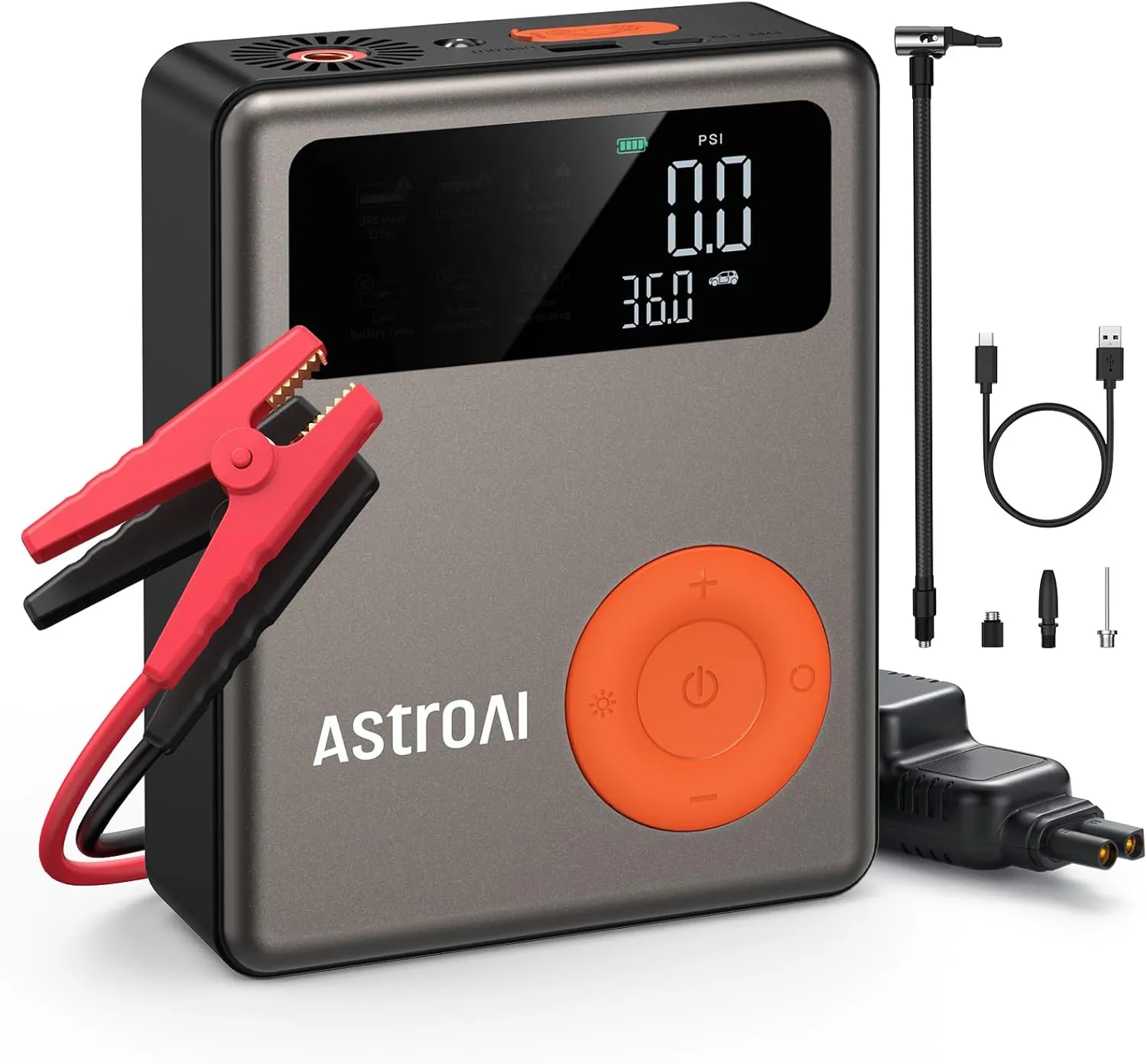
AstroAI Beta822
Official fit: 3000A peak; up to 9.0L gas / 7.0L diesel; 12V. Tire compressor: 150 PSI maximum. Official specifications.
Best for: Road-trip drivers whose engine falls outside the smaller-engine options above but within this model’s rating.
Pros: Broader listed engine compatibility plus auto-shutoff tire inflation.
Cons / Not best for: Broader starting coverage does not prove faster inflation, longer duty cycle or suitability for repeated large-tire refills.
View Beta822 details
The larger-engine option
AstroAI A30
Official fit: 4000A peak; up to 10.0L gas / 8.0L diesel; 12V. Tire compressor: 150 PSI maximum. Official specifications.
Best for: Drivers who actually need its listed engine coverage and still want a combined roadside kit.
Pros: The widest stated engine range among these five linked configurations.
Cons / Not best for: Not automatically the right compressor for RV or off-road tires. The higher starting rating is not evidence of continuous inflation capability.
View A30 details
The specifications that should not make the decision for you
Peak amps are not compressor performance. Start with the manufacturer’s engine compatibility, then assess inflation separately. A higher starting number does not establish airflow, tire-fill time or how long the compressor can run before a pause.
Maximum PSI is a ceiling, not your tire setting. Use the vehicle manufacturer’s recommended cold tire pressure on the placard or in the owner’s manual—not the inflator’s maximum or the maximum marked on the tire. NHTSA’s tire-care guidance explains the distinction.
One charge is not a universal work allowance. Starting attempts and battery-powered inflation draw on the unit’s stored energy. Do not budget a fixed number of starts or tires without matching test conditions. Check charge before travel and follow the exact model’s operating and cooldown instructions.
Auto-stop is not a repair. Reaching a preset pressure does not resolve a puncture or explain recurring air loss. Nor does a successful jump diagnose the battery or charging system.
Buy for the ordinary day—and prepare for the inconvenient one
For occasional commuting emergencies, a compatible combination unit can be a sensible way to keep starting help and tire inflation together. For a larger engine, look at Beta822 or A30’s listed fit. For camping inflatables, pack a suitable separate pump unless the chosen combination explicitly supports them. For frequent inflation or equipment independence, build the kit from separate tools.
Before putting any kit in the trunk, read its manual, identify the correct vehicle connection points and tire-pressure setting, and plan how you will keep it charged and stored within its specified conditions. The useful kit is the one that fits your jobs and is ready when you reach for it.
Frequently Asked Questions
Do I need both a jump starter and an air compressor?
Only if you want to handle both starting trouble and low tire pressure yourself. A jump starter cannot inflate a tire, and an inflator cannot start an engine. A combined unit is convenient for occasional use; separate tools make more sense when one job is frequent or you want independent backup.
Is a jump starter with an air compressor better than separate tools?
Neither format is universally better. A combined unit keeps the two functions together. Separate tools let you choose engine compatibility and inflation capability independently, and a fault in one device need not take the other out of service. You still need to maintain and power both tools.
Does a higher peak-amp rating mean faster tire inflation?
No. Peak amps describe a starting specification, not compressor airflow or duty cycle. Compare the exact engine rating for starting, then look separately at inflation performance, supported tire use and operating limits.
Can a combined unit inflate all four tires in one session?
Do not assume it can from the maximum PSI or peak-amp rating. Tire volume, starting pressure, target pressure, charge, temperature and the model’s operating limits all matter. Follow its runtime and cooldown instructions; topping up mildly low tires is a different job from filling heavily deflated tires.
Can I use a tire-inflator combination for camping inflatables?
Do not assume a tire compressor can replace an air-mattress pump. Check for an explicitly supported high-volume, low-pressure function and the correct valve connection. If that function is not confirmed, bring a separate pump matched to your camping gear.
Can a jump starter and inflator replace roadside assistance?
No. They can help with a compatible starting problem or low tire pressure, but they do not repair a failed battery, a charging-system fault or a damaged tire. If the vehicle or tire is unsafe, or the cause is unclear, stop and get appropriate help.